
Last Tuesday, in a manufacturing plant outside Des Moines, Vice President JD Vance stood in front of an Iowa crowd and reported on what his new federal anti-fraud task force had managed to find in its first six weeks of operation.
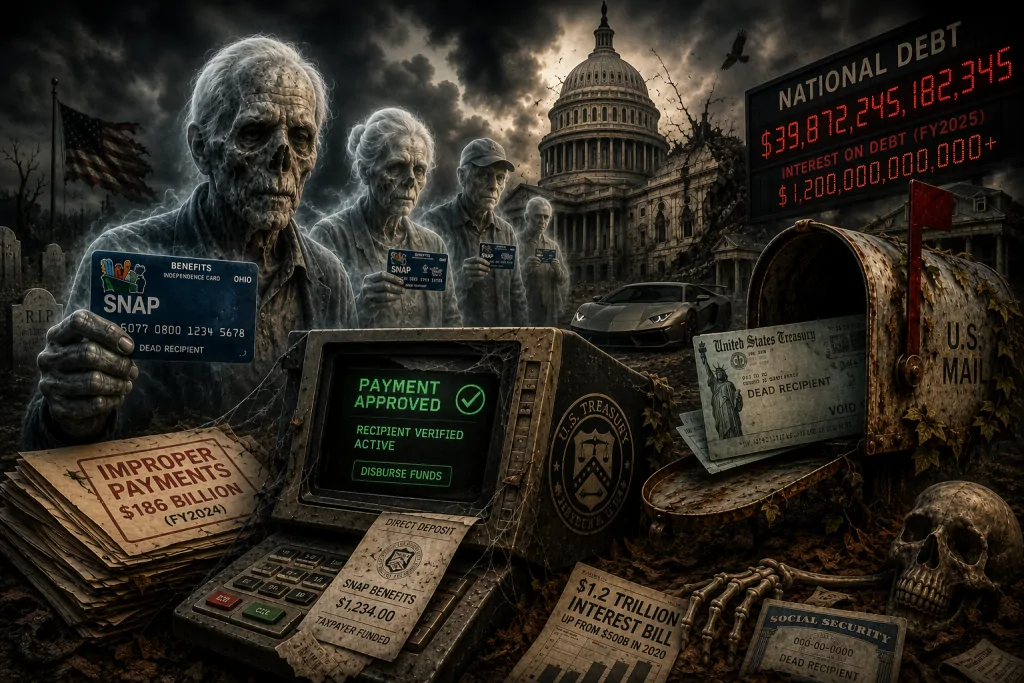
There are 186,000 dead Americans still listed as active recipients of the Supplemental Nutrition Assistance Program (SNAP), formerly known as food stamps.
Another 355,000, he said, are drawing SNAP benefits in more than one state at the same time.
Vance’s task force also managed to identify recipients of taxpayer-funded food assistance who are wealthy enough to drive Lamborghinis.
“Finding fraud in the federal government,” Vance told the crowd, “is kind of like fishing in a barrel with dynamite.”
He’s right. Because this is not the first time someone has wandered into a federal database and tripped over piles of dead beneficiaries.
Earlier this year, the FCC’s inspector general announced that Lifeline— a federally funded program which subsidizes mobile phone service— had been billing the government for phone and internet service to 94,000 dead people.
In total, there were $3.8 million worth of calls that were never made, from phones that were never used, by people who were no longer alive.
Zoom out and it gets uglier. Last year alone, the federal government made $186 billion in “improper payments” — money sent to the wrong person, in the wrong amount, or for the wrong reason.
The Treasury Secretary estimated that outright fraud in the federal budget totals $600 billion each year.
The President signed an executive order on March 16 to set up the Task Force to Eliminate Fraud explicitly to go after that pile, and Vance is chairman.
Every benefit-paying agency in the federal government has near-term deadlines to identify their most fraud-prone programs and start screening recipients for things like… you know… being alive.
Federal investigators are still picking through the fake-daycare and phony-autism-clinic operation that Minnesota’s Somali networks used to bilk US taxpayers out of billions— fraud so brazen it has already produced 90+ federal charges and helped end Tim Walz’s political career.
It is a good start and long overdue.
Unfortunately the fraud that Vance is uncovering is dwarfed by the interest bill on America’s nearly $40 trillion national debt.
That interest bill is now $1.2 trillion annually, up from ‘only’ $500 billion in 2020.
Meanwhile, mandatory spending on Social Security, Medicare, Medicaid, and other mandatory entitlements grew by another $245 billion in FY2025 alone— an 8% jump in a single year.
These are the programs that neither party will touch. In fact, every election cycle, nearly every Congressional incumbent and candidate vows not to touch Social Security, virtually guaranteeing the problem will be kicked down the road until the main trust fund runs dry in a few years.
But even the modest cleanup Vance is talking about will run into a brick wall of litigation.
Whenever the executive branch tries to actually cut something— terminate workers, verify citizenship, clean up voter rolls, claw back fraudulent payments— someone files a lawsuit and a judge issues an injunction.
Federal judges blocked DOGE from accessing Treasury payment systems. A coalition of 20 state attorneys general sued to halt layoffs at more than a dozen agencies. Even relatively modest cuts were tied up in litigation for months.
The ‘justice’ system functions as a ratchet: spending goes up easily, but it almost never comes down. The moment Vance’s task force tries to actually pull a benefit check away from a “dead” recipient, the same injunctions will land on his desk.
But they can’t litigate their way out of reality.
The United States now spends more on interest than on its military, and runs $2 trillion annual deficits with no recession, pandemic, or major war to justify it.
That kind of spending has consequences, and they are already showing up.
It is why inflation has refused to come back down to the Fed’s 2% target. It is why foreign central banks have been buying physical gold at a record pace for four straight years, and now hold more gold than US Treasury bonds for the first time since 1996.
It is why the 30-year Treasury yield is back to 5%, because no one thinks this spending is sustainable.
That also means every new dollar Washington borrows costs more to service. And the same wave hits mortgages, car loans, and small-business credit lines.
Nothing on the horizon breaks this loop.
Which is exactly why it makes so much sense to own the real assets that actually thrive when fiat currency loses its grip: gold, silver, energy, industrial metals, and the well-managed businesses that produce them.