In the year 1484, a thirty-something year old sailor from Genoa was working in Lisbon when he stumbled upon a bold idea.
For the previous decade, he had served as a crewman on several Portuguese commercial expeditions to haul physical resources like gold, ivory, and fish from Asia back to European ports.
These voyages were treacherous; they all crossed into maritime territory controlled by the Venetians, Ottomans, or Egyptian Malmuk. So there was a high likelihood of a vessel being confiscated and its crew being captured or killed.
But through his marriage into a Portuguese navigator’s family, this sailor had inherited a small library of nautical charts. And he spent years studying them and corresponding with scientists who studied cosmology.
Over time, he became convinced that a small fleet could reach Asia by sailing WEST, not east, and arrive to the spice markets of the Indies without passing through enemy territory.
The sailor’s name was Christopher Columbus. And he took his idea to the King of Portugal, John II.
The King was interested enough to convene a royal panel, but the ‘experts’ decided that Columbus had badly underestimated the size of the Earth and recommended against funding the voyage.
Columbus spent the next several years pitching his idea to anyone who would listen.
He sent his brother to make the case to Henry VII in England. He approached the French court. He crossed the border into Spain, secured an audience with Ferdinand and Isabella at Córdoba, and watched a second royal commission argue for nearly four years… before rejecting him for the same reasons the Portuguese had.
He gave up on Spain and was riding north to try the French court again when a royal courier caught up with him. Ferdinand and Isabella had just taken Granada on January 2, 1492 — a conquest that ended a decade-long war and brought the southern Mediterranean coast and its ports under their control.
With the war finally over and the southern frontier secured, the monarchs had excess cash to fund the next strategic venture.
So in April of that year, at the siege camp of Santa Fe outside Granada, Isabella signed the contract. A few months later, three small ships set sail— with the crew probably all assuming that they would not survive the voyage.
The Spanish crown’s investment paid off… and they spent the next century pulling staggering amounts of silver and gold out of the new continent Columbus had stumbled upon; Spain became the wealthiest power in Europe as a result.
This is how governments used to invest. They were like venture capital funds of their day, financing long-term bets on ports, territory, trade routes, and resources, all in an effort to secure strategic assets that compound over generations.
But for the last eighty years or so, the world has run a different experiment.
After 1945, the United States built a system in which the rest of the world manufactured goods, sold them to American consumers, and recycled their trade surpluses back into US Treasury bonds.
This system worked for decades; in fact the most rational thing a foreign government could do with its national savings was invest in US dollars and US government bonds. Any foreign country with a stockpile of Treasurys was considered stable and creditworthy.
But this system is now cracking. Rapidly.
After the Biden administration froze Russia’s dollar reserves in 2022, foreign central banks understood that US government bonds were ‘safe’ only as long as their country stayed on America’s good side.
Consequently, most foreign governments have been diversifying out of dollars ever since.
This year’s Iran war drove the lesson home: the Strait of Hormuz, the narrow waterway through which roughly a quarter of the world’s seaborne oil passes, has been closed since late February.
And every foreign country holding hundreds of billions of US government bonds has been reminded that, no matter how big their Treasury stockpile, they cannot feed their population with it. They cannot fill their people’s gas tanks with it. They cannot power homes with it.
So governments are reconsidering their US dollar positions more than ever.
Just like Ferdinand and Isabella, governments around the world started by acquiring gold; central banks have been buying it at the fastest pace in modern history since 2022.
But gold is only the leading indicator.
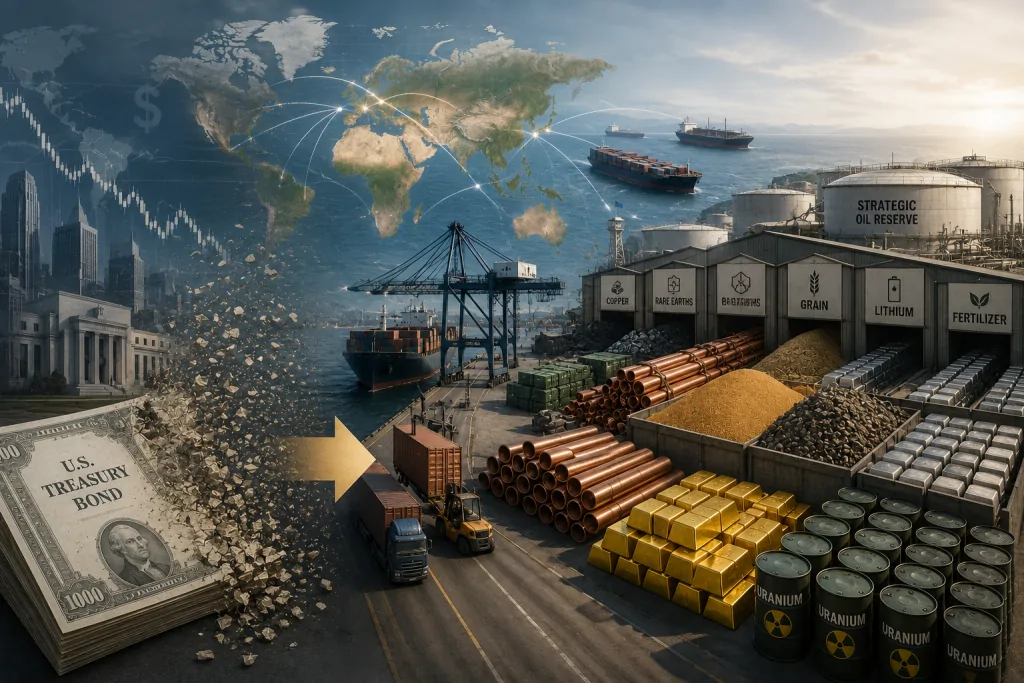
The next phase is foreign governments and central banks stockpiling other critical resources and materials— energy, fertilizer, copper, uranium, rare earths, food production, and even fresh water.
These are all strategic assets that no government can conjure out of thin air. And no amount of paper bonds can magically summon.
China has been running this playbook for fifteen years: they’ve purchased farmland in Africa, copper concessions in the Congo, rare-earth processing across central Asia, and the Belt and Road infrastructure that physically connects the resource to the buyer.
A large part of China’s investment capital has come from their steady liquidation of US Treasury holdings.
This is the Columbus-era calculus all over again. Whereas governments around the world used to stockpile US government bonds, they are now stockpiling strategic resources.
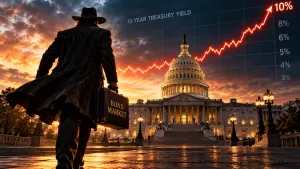
One obvious consequence is lower demand for US government bonds— which drives up interest rates, mortgage rates, and more. It probably also leads to a lot more inflation, i.e. the 1970s all over again.
But it also means that these critical resources— and the companies which produce them— should have a very, very bright future as foreign governments throw potentially trillions of dollars at the commodities sector.
This is the primary thesis behind Schiff Sovereign’s monthly investment research service, Strategic Assets.
We look for profitable, well-managed real-asset businesses with pristine balance sheets that are trading at a low multiple of free cash flow— with clear catalysts for growth.
And those catalysts include our fragmenting world and the scramble to secure physical, critical assets.
Click here to learn more about Strategic Assets and our exceptional track record.