
The Congressional Budget Office just released its annual long-term budget outlook. And, as usual, the numbers are grim.
Also as usual, practically no one in Congress is paying attention.
America’s elected representatives are focused on everything else— virtue signaling, trying to keep illegal immigrants in the country, launching lawsuits against government spending cuts, and generally pretending the country isn’t hemorrhaging cash.
The entire institution is ignoring what is easily the most important issue facing the United States.
America’s future debt crisis is no longer a doom and gloom prediction. It’s arithmetic. And the CBO explains it all very clearly.
According to the CBO, the federal government will spend $7.4 trillion this fiscal year 2026… while collecting only $5.6 trillion in revenue. That’s yet another $1.8 trillion deficit this year.
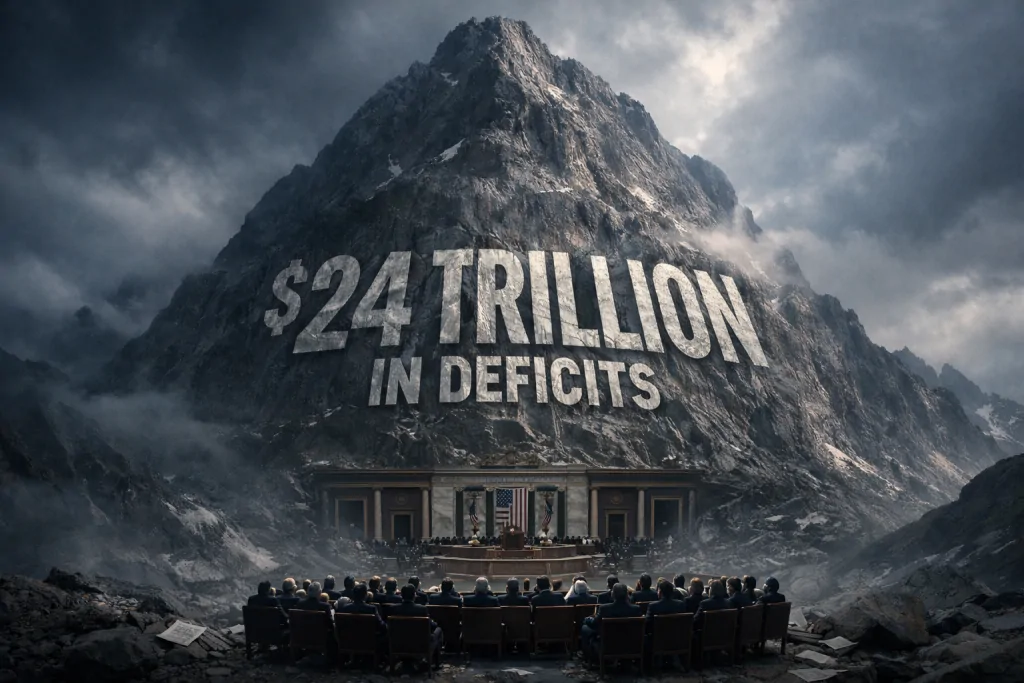
They further project that annual deficits will exceed $3 trillion by the mid-2030s… and that the cumulative deficit over the next decade will reach a combined total of $24.4 trillion. That’s completely insane.
Remember, there are three major categories of federal spending: mandatory spending, discretionary spending, and interest on the national debt.
Even today, interest on the national debt already exceeds military spending. But according to the CBO’s own projections, the interest problem will become much worse.
By 2036, interest on the debt will be roughly equal to ALL discretionary spending combined, i.e. servicing the debt will cost as much as every soldier, every national park, every air traffic controller.
But as staggering as those interest figures are, they’re dwarfed by mandatory spending— which is where the real fiscal catastrophe lives.
Social Security, Medicare, and Medicaid alone will cost nearly $50 trillion over the next decade.
Income security programs (like “SNAP”, aka food stamps), veterans’ benefits, and federal retirement obligations, tack on another $8 trillion in mandatory spending.
That is a staggering sum of money. It averages out to nearly $6 trillion per year in mandatory spending over the next decade.
Just last week we talked about how the government shed roughly 270,000 federal employees over the past year; it was the largest peacetime federal workforce reduction in American history according to the Cato Institute.
Trimming the size of government was obviously the right thing to do. Unfortunately it didn’t significantly reduce the budget deficit. The government still ran a $1.8 trillion deficit in fiscal year 2025 and is expecting another $1.9 trillion this year.
This proves that, while cutting federal workers is helpful, it simply doesn’t move the needle on the deficit problem.
You could literally eliminate ALL discretionary spending— shut down the military, close every national park, fire every border patrol officer, end airport security entirely— and by next year, you would still have a massive budget deficit.
This should have been an easy problem to solve.
Just consider that, in fiscal year 2025, the government collected a total of $5.2 trillion in tax revenue. But as recently as 2019, total federal spending was $4.4 trillion.
So if Congress had simply managed to hold spending steady at 2019 levels, the government would have posted an $800 billion surplus last year.
And even if you adjust for inflation, they would have roughly broken even in 2025— they wouldn’t have even had to make any cuts to balance the budget.
Instead, they just kept piling on. More spending, more entitlements. And very few people in Congress seem to care.
To make matters worse, the CBO’s projections are based on some fairly unrealistic assumptions.
They forecast, for example, that inflation will fall to 2% and remain there for most of the next ten years.
To be polite, that assumption is wildly optimistic and borderline naive.
Think about it— the government will need to borrow $24 trillion over the next decade. That’s a ridiculous sum of money to have to borrow. And who’s going to lend it to them?
Foreign countries are already backing off— many central banks around the world have already been reducing their Treasury purchases (and opting to buy gold instead).
And the US economy doesn’t generate enough private savings (i.e. corporate profits, individual savings) to support that level of government borrowing.
The only remaining lender is the Federal Reserve… which will almost certainly have to step in and print vast sums of money for the government to borrow.
All of that new money, of course, will drive inflation higher. We all saw this firsthand during the pandemic— the Federal Reserve created roughly $5 trillion out of thin air, and the result was 9% inflation.
How much inflation would there be if they have to create $10 or $20 trillion over the next decade? It will probably be more than 2%.
Foreign countries have already figured this out. They can see the discord, the chaos, the ignorance, the complete lack of fiscal responsibility in Congress. And that’s why they’ve been diversifying away from the US dollar— reducing or eliminating their Treasury purchases.
Gold has been the biggest beneficiary of that shift: foreign governments and central banks are trading their dollars for real assets, pushing prices up to record levels.
And this CBO report demonstrates why gold could go much, much higher from here as foreign governments and central banks continue this trend of diversifying away from the dollar.
It’s also why we think that companies in the gold business— mining companies, royalty companies, gold service businesses— are poised to continue performing extremely well.